
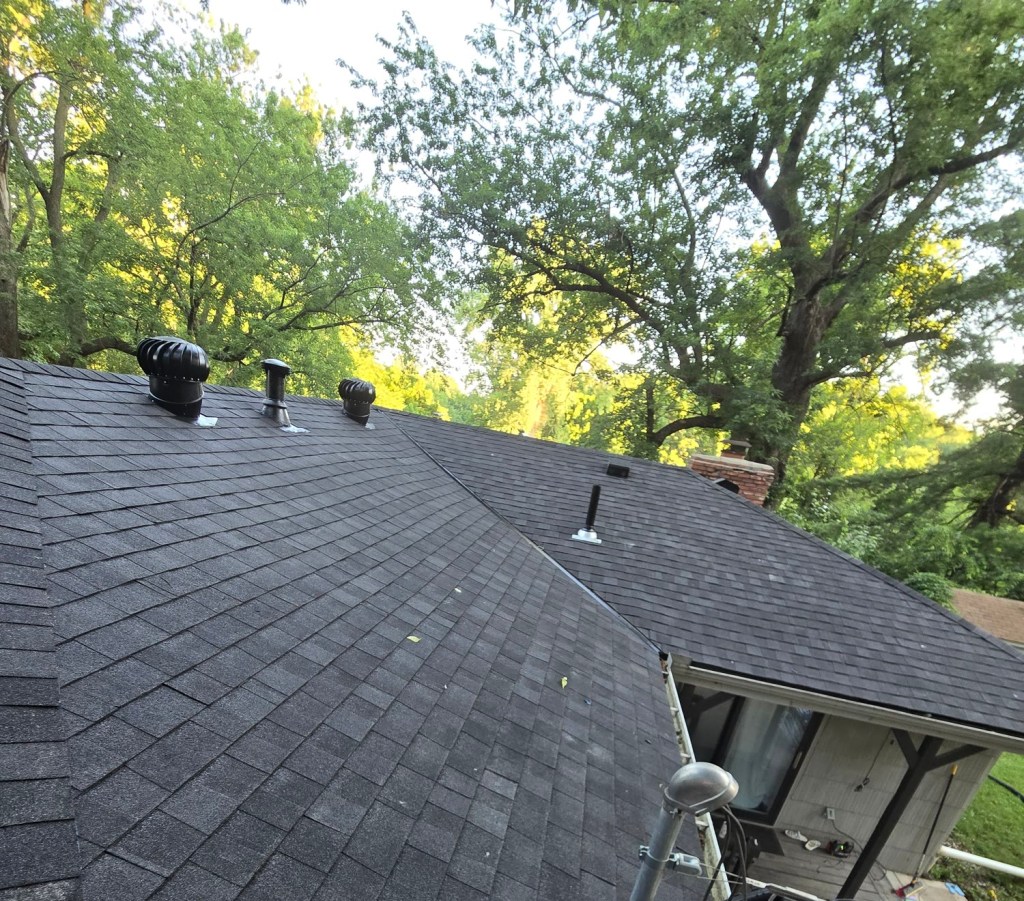
Almost everybody we meet in Kansas City, Kansas has a number in their head. Twenty five years. Thirty years. It came off the shingle wrapper, or off the paperwork from whoever did the roof last, and it has been sitting there ever since as the date the roof is supposed to expire.
That number is a warranty term. It is not a lifespan, and it is not a promise about your house. Two identical roofs, same shingle, same wrapper, installed the same week on the same street here can be years apart in when they actually need replacing. What separates them is not luck. It is three things, and one of them is entirely inside your control.
A warranty is a legal document, not a forecast
A shingle warranty describes what the manufacturer will do if the product itself fails in a defined way. It is written around manufacturing defects. It is not a statement that the roof will keep shedding water for that many years on your house, in your climate, over your attic.
The trade body for the people who actually make the shingles is careful about this. The Asphalt Roofing Manufacturers Association does not promise a set number of years. Its FAQ only says a roof past 20 years old is a prime candidate for reroofing. What its guide to the roofing system stresses instead is the list of things the roof needs in order to perform: a starter strip at the eaves, ice and water barrier in the vulnerable areas, underlayment, the shingles themselves, hip and ridge product, and ventilation. Their framing is that a roof is a system, and that the system is what lasts, not the shingle on its own.
So the honest answer to “how long does a roof last in Kansas City” is that it depends on how hard this specific climate works it, and on whether the system underneath it was built correctly. Here is what does the work.
One: thermal cycling, and Kansas City has plenty of it
Asphalt shingles do not fail all at once. They age through repeated stress. Researchers at the National Institute of Standards and Technology list the stresses shingles face in service: ultraviolet radiation, thermal cycling, humidity swings, freeze and thaw, and mechanical loads like wind uplift and hail impact. In their NIST study, they note that earlier research found weathered shingles resist mechanical loads less well, and in their own lab test the adhesive strip changed chemically.
That adhesive strip matters more than most people realise. It is the seal that bonds each course of shingles to the one below it. It is what stops the wind getting underneath. When it has been cooked and cooled and cooked again for enough years, it stops gripping, and a roof that looks perfectly intact starts losing shingles in a storm that would not have touched it when it was new.
Now put Kansas City numbers against that. NOAA’s 1991 to 2020 climate normals for Kansas City International put the average July high at about 88 degrees and the average January low at about 20 degrees. That is a routine annual swing of roughly 68 degrees at the two ends of a normal year, before you count the days that run well past both. On a dark roof deck in direct sun the surface temperature runs far higher than the air temperature in July. Every one of those cycles is the expansion and contraction NIST is describing.
This is the part of the answer nobody can change. If your roof is in Wyandotte County, it is being worked harder than the same shingle would be in a mild coastal climate, and the number on the wrapper did not know that.
Two: freeze and thaw, and where water gets in
The same temperature range produces the other stressor on the NIST list. NOAA’s climate normals for the downtown Kansas City airport show about 70 days a year that freeze at night and thaw in the daytime. Water gets into a small gap, freezes, expands, opens the gap slightly, thaws, and goes in a little deeper next time.
That process is why the vulnerable parts of a roof here are almost never the middle of a slope. They are the eaves, the valleys and the flashings, which is exactly where ARMA specifies ice and water barrier. On the north facing slopes, which hold snow longest, ice damming is a genuine risk rather than a theoretical one.
A roof that was built with ice and water barrier at the eaves and in the valleys handles this. A roof that was built without it, to save a little on the job, ages from the edges inward, and the homeowner finds out about it years later as a stain on a ceiling.
Three: attic ventilation, which is the one you can control
Here is the part worth actually checking this week, because it is the one variable a homeowner can do something about and almost nobody has looked at it.
ARMA’s roofing system guide is explicit that proper ventilation, meaning balanced intake and exhaust, helps extend the service life of an asphalt shingle roof by reducing attic temperature and removing condensation from the attic space. Reducing attic temperature attacks the thermal cycling problem from underneath. Removing condensation attacks the moisture problem.
The building code puts a number on it. Section R806.2 of the International Residential Code requires a minimum net free ventilating area of 1/150 of the vented space. There is an exception allowing 1/300, but it is conditional, and one of the conditions is that not less than 40 percent and not more than 50 percent of the required ventilating area sits in the upper portion of the attic, no more than 3 feet below the ridge, with the balance in the bottom third.
Read that condition again, because it is the whole point. The code is not just asking for holes. It is asking for holes at the top and holes at the bottom, in balance, so air actually moves through. A roof with ridge vent and no soffit intake is not ventilated. It is a roof with a vent on it. The air has nowhere to come from, so nothing moves, the attic bakes, and the shingles get cooked from the underside as well as the top.
We tear off roofs in this metro that are visibly older on the slopes above the hottest, worst ventilated part of the attic. Same shingle, same install date, same weather, different rate of ageing, because the air underneath was not moving.
What this means for deciding
Put the three together and the question stops being “how old is it” and becomes a set of things you can look at.
- Are the shingles losing granules generally, or only in one spot? General loss across the slopes is age. Local loss is damage, and damage is often a repair.
- Do the shingles crack when they are lifted? Brittleness is the thermal cycling showing up. A brittle roof cannot be repaired reliably, because working on it creates the next leak.
- Are shingles lifting or coming off in ordinary wind? That is the sealant strip letting go, which is the failure NIST and earlier wind studies point to.
- Is there intake ventilation at the soffits, and is it actually open? Blown insulation pushed into the eaves blocks intake completely, and it is extremely common.
- Has it been patched more than once in different places? Two repairs in two seasons in two locations is usually the roof telling you something.
None of that requires knowing the install date, which is useful, because on a lot of the older housing stock on the Kansas side nobody knows it anyway.
Common questions
My shingles say 30 year. Why would I replace at 20?
Because the 30 is a warranty term describing the manufacturer’s obligations if the product is defective, not a prediction about your house. Climate, install quality and attic ventilation all move the real number, and Kansas City’s temperature range works a roof harder than a mild climate does.
Can better ventilation actually extend the life of a roof I already have?
It can help, and it is worth correcting regardless, because the alternative is continuing to cook the roof from underneath. It will not reverse ageing that has already happened. The bigger win is making sure the ventilation is right when the roof is replaced, so the new one gets a fair run.
How do I check my own attic ventilation?
Look for intake at the soffits and exhaust near the ridge, and check that the soffit intake is not blocked by insulation, which is the most common problem we find. The code framework is balance, with 40 to 50 percent of the vent area up near the ridge and the rest low. If you only have one or the other, air is not moving.
Is it always replacement, or can a roof this age be repaired?
Plenty of roofs we look at get repaired, and we will tell you when that is the right answer. The dividing line is whether the problem is local or general. One failed pipe boot on an otherwise sound roof is a repair. Brittle shingles and general granule loss across every slope is not.
If you want a straight answer on yours
We would rather look at it than guess, and so would you. A free roof inspection gets us on the roof, slope by slope, with photographs, plus a look in the attic for the ventilation question above. You get a recommendation, including when that recommendation is that the roof is fine and you should spend the money on something else.
When it genuinely is time, our roof replacement work is a full tear off to the deck, new flashing, ice and water barrier at the eaves and valleys, and ridge vent with real intake, so the next roof gets the run this one did not. And if a storm is what put you on this page, start with how to tell whether hail actually damaged your roof, because insurance may carry most of it.
Call or text (913) 725-8790. Family owned here since 2017, an owner on every job, and open 24 hours.